
Concrete Construction Tech: Laser Screed & Robotics on the Rise
– By #Lester-Robbins Construction

Picture flattening wet mud the size of four football fields, making it so perfectly level that a dropped marble never rolls. According to logistics experts, this extreme precision is mandatory for giant industrial warehouses to operate safely.
Adding to this monumental challenge is a relentless ticking clock. Even with modern concrete, the material is essentially "liquid rock," meaning construction crews face a brutally short window to smooth massive surfaces before it turns to stone.
Industry data reveals this flawless finish once required armies of workers enduring backbreaking labor on their hands and knees. Today, driven by concrete innovation, construction tech relies on lasers, making new technology in concrete construction a true engineering marvel.
The Reality of Manual Leveling
Imagine trying to smooth out a swimming pool filled with heavy, wet oatmeal before it turns to solid rock. For decades, concrete finishers achieved this through a grueling process called "screeding," dragging a heavy wooden board across the wet surface. Their goal was twofold: making the surface "flat" (smooth like glass without bumps) and "level" (perfectly horizontal so a marble won't roll away). Doing this by hand across a massive warehouse meant fighting a constant race against the clock.
This race took a severe toll on the human body. The physical demands of traditional screeding techniques included:
- Dragging heavy tools loaded with unyielding pounds of wet mix.
- Facing repetitive motion risks from bending and pulling boards for hours.
- Battling environmental stressors like blistering heat, which accelerates the hardening process.
Because workers naturally fatigue, manual concrete leveling often left tiny dips or slopes in the floor that only became obvious once the slab cured. Modern construction methods needed a way to remove this exhaustion-driven error entirely. That necessity paved the way for how the "Invisible String" revolutionized big-box floors.
How the 'Invisible String' Revolutionized Big-Box Floors
Stepping away from the exhaustion of heavy boards, modern builders found a brilliant solution: using light as an unbendable ruler. When evaluating a laser screed versus manual concrete leveling, the biggest difference is removing human fatigue entirely. A spinning beam of light acts like an invisible string stretched tightly across the room, providing a perfect guide that never sags.
A stationary transmitter fires a flawlessly level sheet of light over the freshly poured concrete. As the machine drives, sensors read this light, adjusting the scraping blade automatically hundreds of times per second. For anyone wondering how laser screeds improve floor flatness, this instantaneous, robotic adjustment to the light beam is the exact answer.
_______________________________________
“We purchased our first laser screed in 2020, and it completely changed the complexion and trajectory of our company. The laser screed provided us with the highest level of accuracy possible, which helped achieve extremely flat floors with high flatness and levelness requirements. Installing the 3D profile system was another game changer, as it allowed our trained supervisors to arrive at a jobsite, build a 3D model of the desired finished product, upload it to the screed, and we are ready to go! This technology has eliminated extra form work and allows us to pour large scale paving and complicated site concrete that would otherwise take several days without the screed. This piece of equipment and the supporting automation technology has increased production, cut down on the more grueling manual labor, and allowed us to compete for contracts we would have never considered prior to 2020. We are one of only a couple concrete contractors in the region with 3D screeding capabilities!”
________________________________________
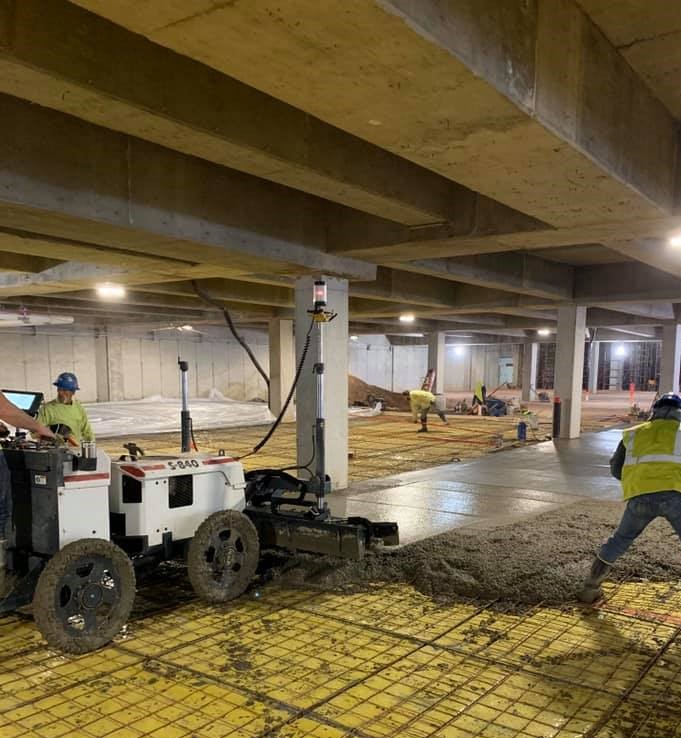
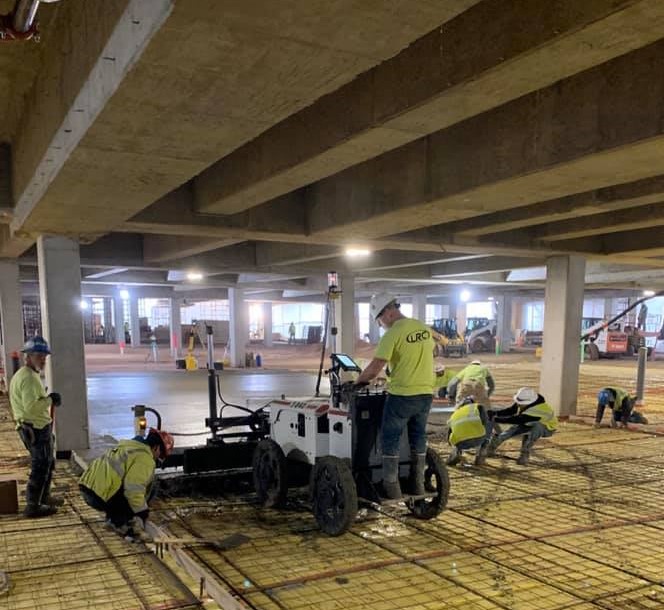
This extreme precision is the unseen backbone of modern warehouse logistics. Massive distribution centers demand surfaces so smooth that forklifts carrying heavy loads can race at high speeds without tipping over. Advanced systems use 3D laser profiling to map the wet laser screed concrete in three dimensions, ensuring zero microscopic dips exist to threaten towering racks of goods.
Shrinking a grueling week-long task for thirty people down to a single day changes how quickly our world is built. As autonomous concrete leveling equipment handles the heavy scraping, human operators simply supervise the strategy.
The 'Roomba' on a Construction Site
The moment the floor is flat, the ticking clock of curing demands immediate attention.
Handing this labor over to machines radically transforms site safety but automation doesn’t start at the slab. Today’s contractors are also leveraging AI-powered estimating and bidding software long before concrete is poured, using predictive data and real-time cost modeling to sharpen bids, reduce risk, and win more of the right projects. Together, these technologies are reshaping the entire lifecycle of construction from the office to the jobsite.
The high-precision robotic concrete finishing benefits are undeniable for modern contractors:
- Reduced physical strain, completely ending severe joint injuries from manual troweling.
- Millimeter-level precision, keeping giant warehouse surfaces perfectly uniform for heavy machinery.
- Continuous operation without fatigue, allowing the machine to work flawlessly right through the final hour.
Building Smarter: Sustainability and the Modern Workflow
Every extra inch of concrete poured across a massive warehouse floor wastes tons of heavy material. By using laser-guided systems to measure the exact amount of "industrial dough" needed, contractors instantly support sustainable construction goals. These invisible light strings prevent over-pouring, saving thousands of gallons of water and drastically reducing the cement's overall carbon footprint.
Finding enough hands to shovel and smooth this heavy material is a growing challenge worldwide. Whether observing a local Black Hills development or a massive airport expansion, machines are stepping in to fill severe labor shortages. Modern guidelines for implementing automation in concrete construction emphasize the efficiency of this technology for the processes on a jobsite, but the support it will provide for the workers as well.
Ultimately, this tech-integrated workflow delivers an incredible return on investment. Projects finish days faster with zero wasted material and a healthier crew, permanently transforming the future under your feet.
The Future Under Your Feet
The flat floor beneath your feet isn't just poured mud; it is a marvel of modern building technology. By trading strict manual labor for laser-guided concrete techniques, we have turned a chaotic liquid into an exact science. These concrete advancements guarantee safer warehouses and smoother airport runways.
The next time you walk through a superstore, look down at that flawless surface. You are experiencing one of today’s most impressive concrete solutions. If laser tech and invisible light can perfectly “print” acres of a concrete floor today, imagine what the future of AI in concrete construction will help us build tomorrow!
Your Concrete Pros in the Rapid City and Black Hills
Today’s concrete construction isn’t just about pouring slabs, it’s about delivering smarter, faster, and more accurate results from the ground up. These innovations highlight exactly what top-tier contractors bring to the table: efficiency, durability, and unmatched attention to detail.
At Lester-Robbins Construction, this isn’t future talk - it’s the standard. Serving Rapid City and the Black Hills, our team combines proven craftsmanship with modern technology to deliver concrete work that performs as flawlessly as it looks. Whether it’s large-scale commercial floors or local projects built to last, Lester-Robbins stands as the concrete pro you can trust to get it done right the first time.
Last Modified: